The invasion of Venezuela continues the long, brutal history of US imperialism in Latin America.
From the overthrowing of Guatemala’s democratically-elected president, Jacobo Árbenz, in 1954, to the Chilean coup of 1973 that instilled a murderous right-wing dictatorship, to the stoking of civil war in Nicaragua in the 1980s, the history of US policy in Latin America is replete with brutal repression.
There is no reason to believe that Trump’s attacks on Venezuela will be any different. Yes, Nicolás Maduro is a dictator who undermined democracy, but this invasion has nothing to do with democracy, or what’s best for the people of Venezuela.
Indeed, Trump has made it crystal clear what this act of imperialism is about.
“We’re going to be taking a tremendous amount of wealth out of the ground,” Trump told reporters, as he explained their goal: run a campaign of coercion until the Venezuelan government allows its oil resources to be controlled by US fossil fuel companies.
The history between oil and war is―like the history of US imperialism in Latin America―long and sordid. According to research from Harvard, between 25% to 50% of all wars between 1973 and 2013 were connected to oil interests.
And battles for the right to extract oil is not the only way fossil fuels cause war. Between 2006 and 2009, climate-driven drought and crop failure in Syria pushed 1.5 million people to abandon rural areas for urban ones. In part, it was this mass displacement and hunger that created the destabilization of the country that led to the Syrian civil war that claimed over 450,000 lives.
All of this, I think, means two things. First, as Americans, living in the heart of the imperial machine, we must do everything we can to call out this invasion and throw sand in the gears of Trump’s authoritarianism at every turn.
This weekend, there were protests denouncing the invasion in more than 100 cities. There should be many more. And as we call out the invasion of Venezuela, we also need to keep focused on the fact that Trump has just caused the cost of healthcare to rocket for tens of millions of Americans―it’s not hard to imagine that part of the reason for the attack on Venezuela was to distract us from this fact.
Secondly, as Bill McKibben pointed out, one of the best ways that we can reduce the motivation for this kind of naked imperialism is to reduce our dependency on oil. “It’s going to be hard to figure out how to fight wars over sunshine,” writes McKibben.
There are many things that we can do to reduce our dependency on oil and gas. We can fight to elect climate champions. We can advocate for state legislative bills that help move the needle. We can push local regulators to make it easier to put solar panels on roofs and balconies.
Here at Stop the Money Pipeline, we’ll remain focused on what we know best: pushing banks, insurance companies and investors to throw their weight behind a rapid and just energy transition.
But if this invasion has made anything clear, it’s that this work is going to take bucketloads of resolve.
It can be easy to despair when you wake up to headlines about Trump’s latest insanity. But that’s exactly what they want from us. And we need to fight that sense of despair at every turn.
In my 10+ years of being an activist, I’ve found that the greatest antidote to despair is being involved in a community that is dedicated to fighting for a better world. It’s by being in community that we find the resolve needed to keep going when things get tough.
In recent years, with the advent of Zoom, I fear that this kind of community organizing has been in retreat. But it’s so, so important, especially now.
So, if you’re not already involved in a local community group fighting to end the twin threats of fossil fuels and Trump’s authoritarianism, I hope you’ll consider finding a group in your area.
There are lots of ways to get plugged in. You can find a Stop the Money Pipeline partner in your area. If you’re over 60 you can join a Third Act local group, or, if you’re younger, a Sunrise Movement local hub. Many 350 local groups and Sierra Club chapters are continuing to do great work, too. And there’s now 1000+ Indivisible local groups fighting back against authoritarianism.
So whatever you do with your year ahead, I hope it involves getting offline, getting into community, and getting involved. Social movements, after all, are supposed to be social.
And as Trump’s invasion of Venezuela reminds us, the stakes couldn’t be higher.
In Solidarity,
– Alec Connon, Stop the Money Pipeline coalition director
News & Updates from the Coalition
– European Pensions Dump BlackRock
After incredible work by campaigners in the Netherlands, the Dutch pension fund PME dumped $5.9 billion from BlackRock, citing concerns the world’s largest asset manager wasn’t doing enough to manage climate risk. The move follows another Dutch pension fund, PFZW, shifting $17 billion away from BlackRock in September, and one of the UK’s largest pension funds―the neatly-named “People’s Pension”―divesting $28 billion from State Street.
In all, European pensions have moved $50.9 billion out of BlackRock and State Street, citing climate concerns. Now if only we could get some of those large pensions in blue states to pull their weight…
– But New York Declines to Follow Suit… For Now
After years of campaigning, Comptroller Lander finally announced in his final weeks in office that he was recommending that the city’s pension funds move $42.3 billion away from BlackRock. Unfortunately, he waited until the final weeks of his four years in the office and wasn’t able to get it over the finish line.
However, with new Comptroller Mark Levine in office, he’ll hopefully pick up the baton and get the job done. Our partner, New York Communities for Change, has led this campaign and you can check out their thoughts here and here.
– State legislative season ramps up!
While climate action may be dead at the federal level, there’s still so much that can be done at the state and local level. And lots of our coalition partners are championing bills this state legislative session.
Some of the key bills we’re keeping an eye on, include a coal divestment bill in Washington, a bill that would place a climate surcharge on business between insurance companies and fossil fuel companies in Connecticut, and a pair of bills that would address the insurance industry’s role in the climate crisis in New York. Expect details on how you can support key climate bills in your state soon.
– Local Leads, Global Impacts
To strengthen the climate movement, we’re running a new program to support campaigners advancing key strategies to end the fossil fuel industry.
Over 9 months, a cohort of 13 campaigners shall receive deep mentorship and training to support their development as campaigners. Training will be provided by experts from the American Federation of Teachers (AFT), the Communication Workers of America (CWA), Little Sis, and others.
Training topics include power mapping and strategic research; organising 1:1 conversations and how to build effective organizing committees; designing effective narrative strategy; and how to run and win campaigns at the local level. Participants in the program include campaigners leading Make Polluters Pay campaigns and campaigns to stop the fossil fuel build out in the Gulf South.
– Understanding how public pensions are key actors in the climate fight!
This year-in-review piece from our old friend Ben Cushing over at the Sierra Club is a worthwhile read.
In it Ben outlines key steps that pensions can take to move the needle on climate. He also outlined these steps in this really thoughtful research paper. Bill McKibben called the paper “probably the best account of the folly of our financial system.”
– the normally sleepy National Association of Insurance Commissioners gets a wake up call
Every year, Insurance Commissioners meet up for an annual gathering. Normally, the gathering doesn’t generate a lot of headlines. But this year, insurance commissioners were met by groups of activists and flooded with tens of thousands of emails calling out insurance companies for continuing to finance fossil fuels, even as they abandon communities and raise rates across the country.
You can read all about it in this blog from our partners at Public Citizen.
– Bank of America in the spotlight
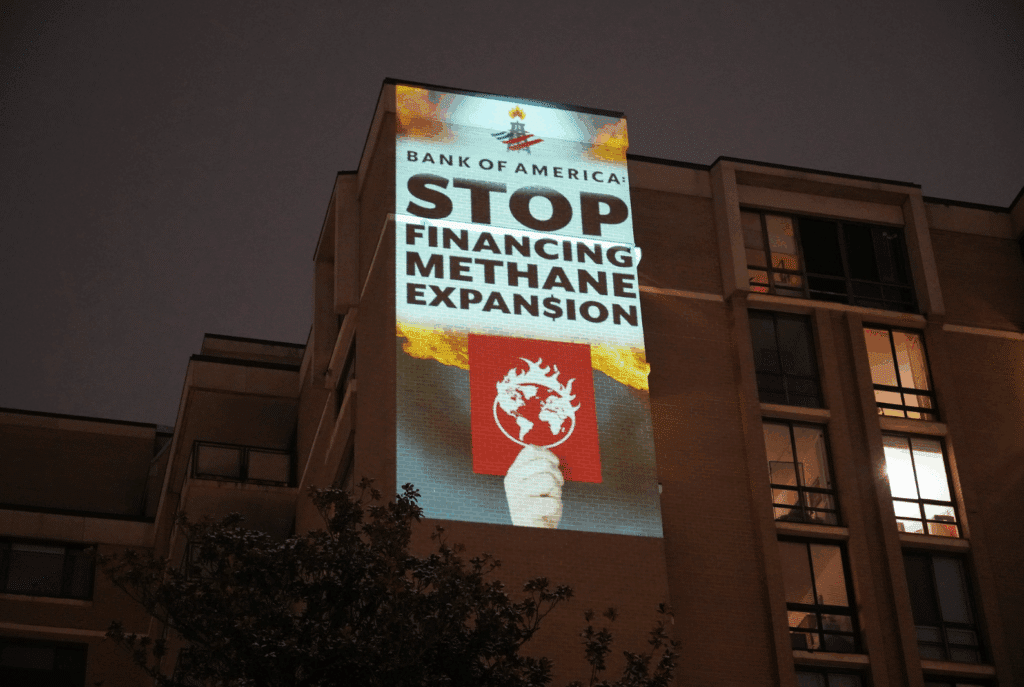
I’ll leave you with this great image, which our friends at RAN displayed outside a FIFA World Cup draw at the Kennedy Center in DC.
Bank of America is spending millions to sponsor the 2026 World Cup, but so long as they spend billions to finance the buildout of toxic LNG (methane) export infrastructure in the Gulf, they can expect reminders like these to pop up at World Cup venues around the country: